Campaign Performance and Customer Composition Analysis Dashboard
An end-to-end Power BI case study analyzing marketing campaign performance, customer composition, and purchase drivers for a retail food and beverage business.
Project Overview
This project helps stakeholders understand which marketing campaigns drive revenue, who the most valuable customers are, and what factors influence purchasing behavior.
- Evaluate campaign performance by purchases and revenue
- Identify top-performing products and channels
- Analyze customer demographics and behavior
- Determine key purchase drivers
Problem Statement
Despite running multiple marketing campaigns across various products and sales channels, the business lacks a centralized analytical view to clearly evaluate performance and customer behavior. As a result, key business questions remain difficult to answer:
- Which marketing campaigns generate the highest revenue and purchase volume?
- Which product categories contribute most significantly to total sales?
- Who are the most valuable customer segments?
- What factors most strongly influence campaign acceptance and customer spending behavior?
Without a unified analytical solution, marketing decisions risk being driven by assumptions rather than data-driven insights, limiting campaign optimization and effective resource allocation.
Project Objectives
The objectives of this project are to:
- Assess marketing campaign effectiveness based on purchases and revenue
- Identify top-performing products and sales channels
- Analyze customer demographics and purchasing patterns
- Determine key drivers influencing campaign acceptance and sales value
- Present insights in a clear, executive-friendly format for data-driven decision-making
Campaign Performance Analysis Dashboard
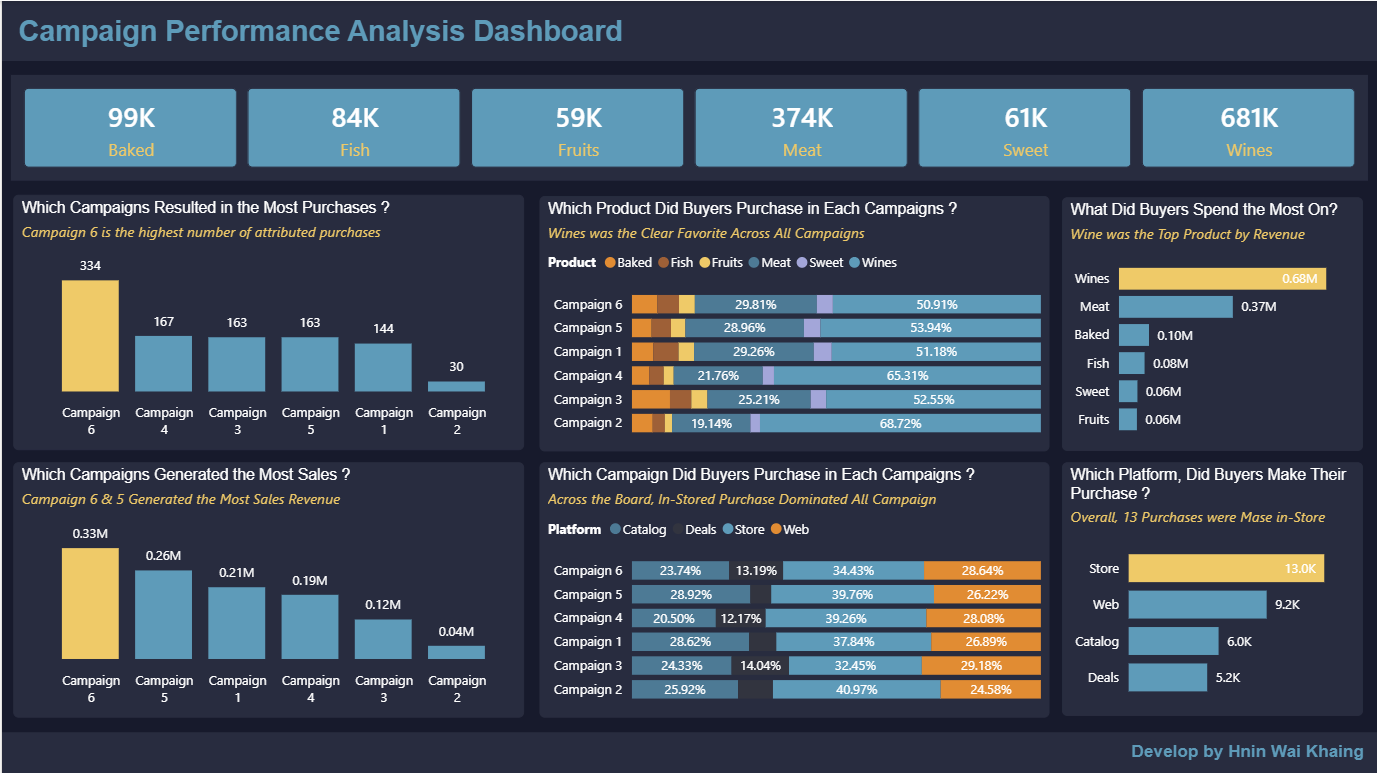
This dashboard evaluates the effectiveness of marketing campaigns by comparing purchases, revenue contribution, and product performance. The analysis shows that Campaign 6 achieved the strongest results, generating the highest purchases and overall business value. It also highlights that wine was the top revenue-generating product category, suggesting that both campaign strategy and product focus influenced performance.
Key Takeaway
Campaign performance is uneven, with a small number of campaigns driving a large share of outcomes.
Business Recommendation
Increase investment in high-performing campaigns and replicate their targeting and promotional strategy across weaker campaigns.
Customer Composition Analysis Dashboard
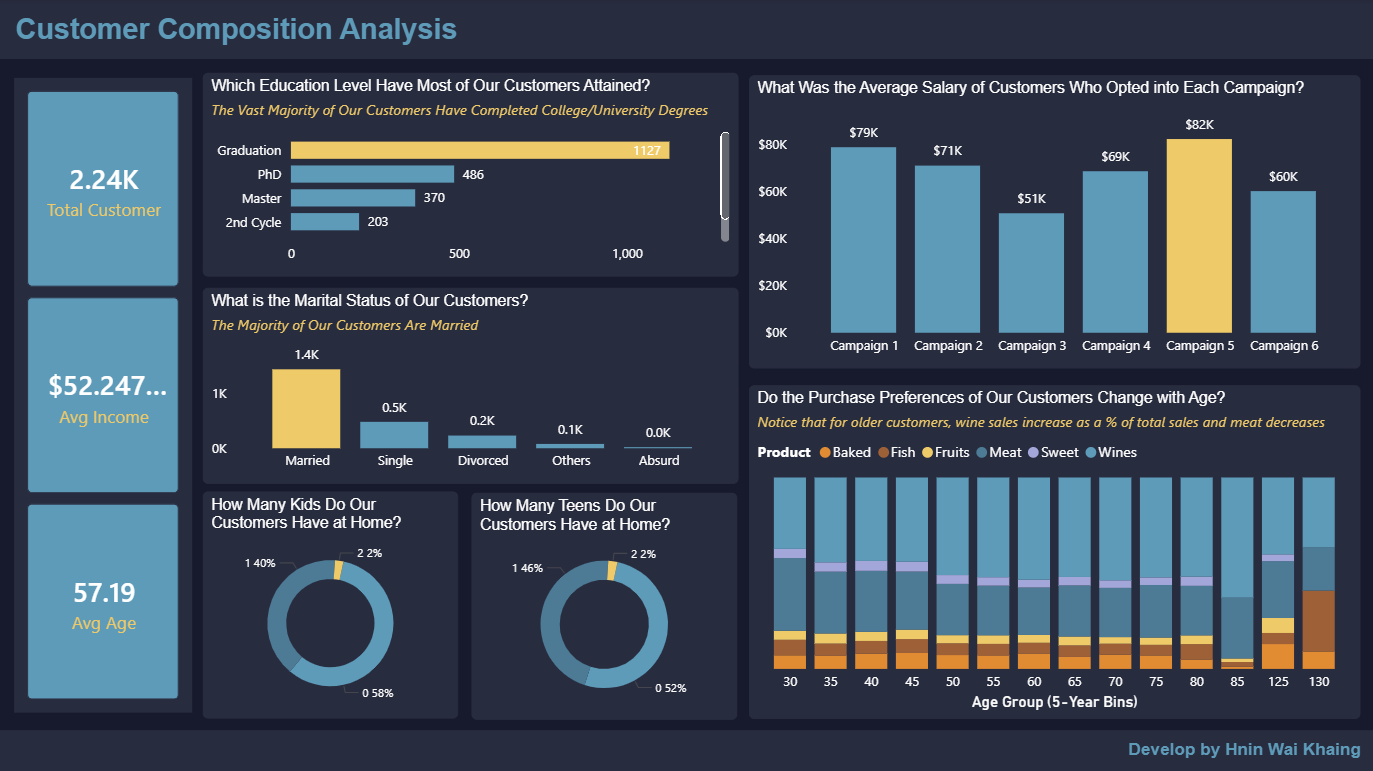
This dashboard explores the demographic and socioeconomic composition of customers to identify the most valuable segments. The analysis reveals that high-income, middle-aged customers contributed the largest share of sales, making them the most commercially important customer group. Education and household characteristics also provide useful context for understanding purchasing patterns.
Key Takeaway
Revenue is concentrated among specific customer segments rather than being evenly distributed across the full customer base.
Business Recommendation
Develop more targeted campaigns for high-value customer groups through personalized offers, loyalty strategies, and premium product positioning.
Purchase Driver Analysis
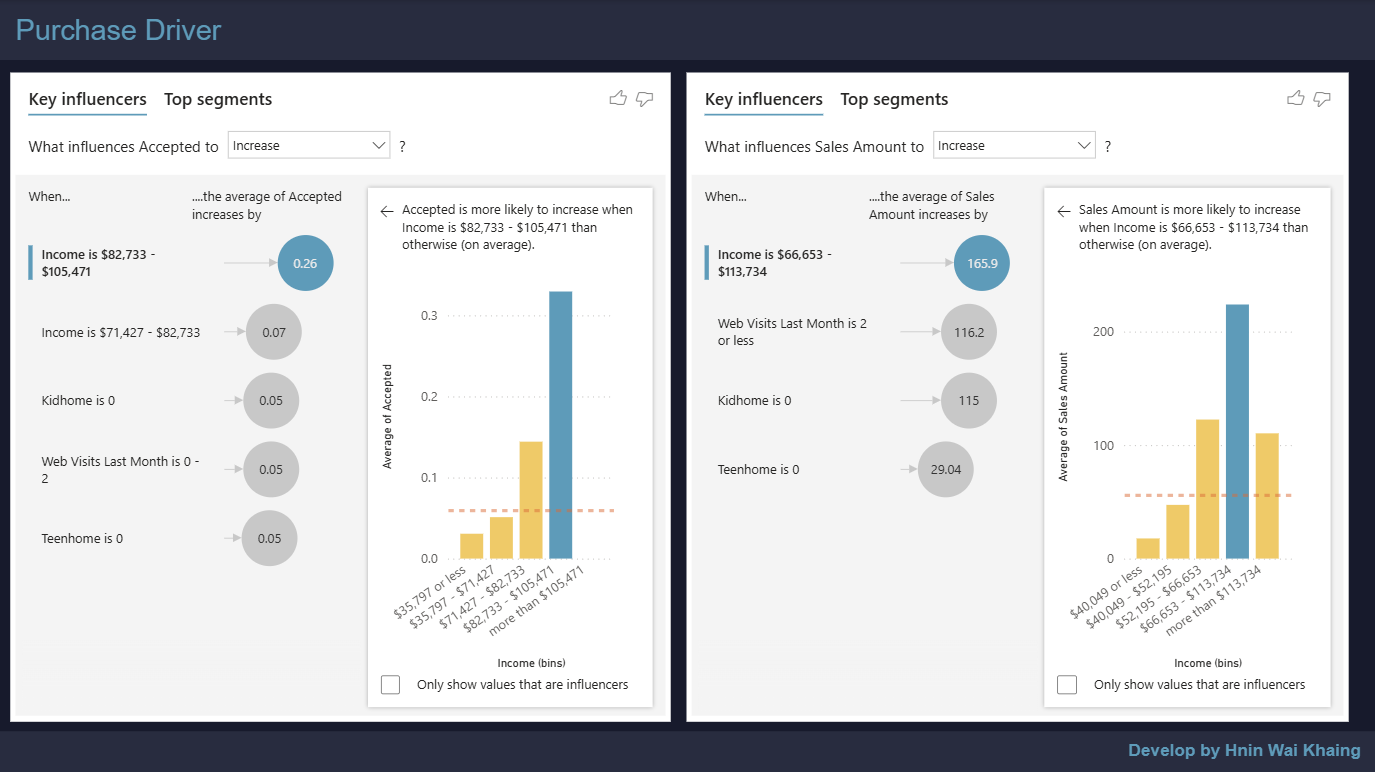
This dashboard identifies the key factors influencing campaign acceptance and spending behavior. The analysis shows that income level is the strongest purchase driver, with additional influence from customer profile characteristics and past purchasing behavior. These findings demonstrate that customer decisions can be better understood through measurable attributes rather than broad assumptions.
Key Takeaway
Customer purchasing behavior is strongly influenced by identifiable demographic and behavioral factors.
Business Recommendation
Use segmentation and predictive targeting to improve campaign efficiency and focus on customers with the highest likelihood of conversion.
Key Insights, Recommendations, and Business Impact
This project analyzed campaign performance, customer composition, and purchase drivers to identify which campaigns generated the highest value, which customer groups contributed most to sales, and what actions could improve marketing effectiveness.
Campaign Performance
Campaign 6 achieved the highest purchases and revenue, indicating a more effective targeting and campaign strategy compared to others. This suggests stronger targeting, messaging, or timing compared with lower-performing campaigns.
Recommended Action
Reallocate more budget toward Campaign 6 and evaluate its structure to replicate success across weaker campaigns.
Product Performance
Wine emerged as the highest revenue-generating product category, showing stronger commercial value than other products included in the campaigns.
Recommended Action
Prioritize wine in future promotions, create bundle offers, and optimize pricing strategies around high-performing products.
Customer Segmentation
High-income, middle-aged customers represented the most valuable customer group and contributed a significant share of overall sales.
Recommended Action
Develop targeted campaigns for high-value segments using personalized offers, loyalty strategies, and premium product positioning.
Channel Performance
In-store purchases dominated digital channels, indicating stronger offline buying behavior and untapped potential in online engagement.
Recommended Action
Strengthen digital campaigns through retargeting, social ads, and email marketing to improve online conversion and channel balance.
Purchase Drivers
Income level was the strongest driver of both campaign acceptance and spending, supported by customer profile and prior purchase behavior.
Recommended Action
Apply income-based segmentation and predictive targeting to improve campaign efficiency and increase conversion quality.
Business Impact
- Enabled data-driven campaign budget allocation based on performance.
- Improved marketing ROI by focusing on high-performing campaigns.
- Identified high-value customer segments for targeted marketing.
- Supported revenue growth through product-focused promotion strategies.
- Provided actionable insights for optimizing digital vs in-store channels.